

What AI is doing to Scrum and to the way software teams work. The questions I worked through:
What changed in December 2025? Andrej Karpathy put it bluntly: “coding agents basically didn’t work before December.” His own ratio flipped from roughly 80% manual / 20% agent in November to 80% agent / 20% manual in December. The bottleneck Scrum was built around (humans typing code) effectively went away in a matter of weeks.
What was Scrum designed to do? Solve the waterfall problem. The fix was empiricism: small teams that own the entire software lifecycle from spec to maintenance, shipping working software every sprint, collecting real feedback, and letting what they learn shape what they build next.
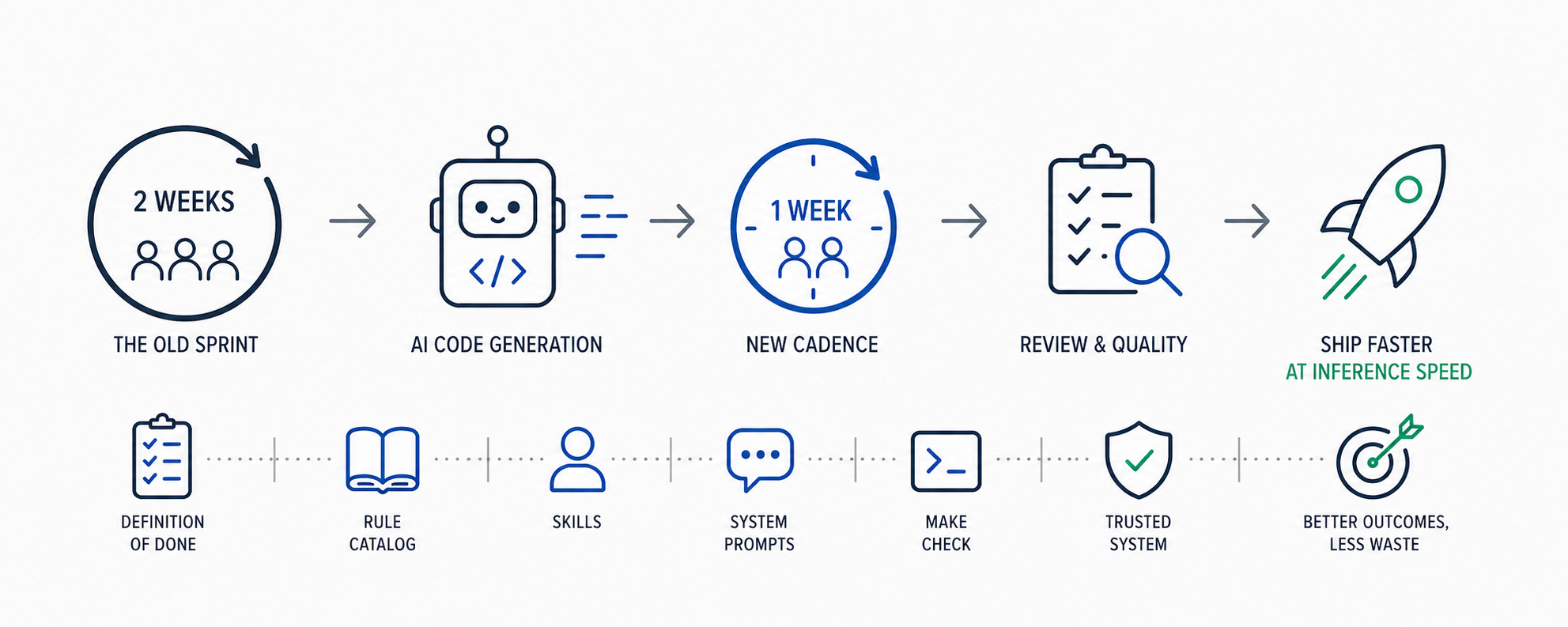
How is AI impacting software teams? Teams compress (2–4 humans), sprints compress (one week), and the team’s attention shifts from grooming a backlog to reviewing what the agents produced and maintaining the rules that decide which of it is worth keeping.
Why most teams aren’t profiting from the new tools. AI is an amplifier: it makes good teams faster and bad teams faster at producing slop. The teams that win aren’t the ones that adopted the tools first; they’re the ones that built the discipline around them.
How do we actually leverage AI? How do we build systems we can trust? How do we ship code at inference speed that no human ever read? By codifying the discipline into the system the agent operates inside: the Definition of Done, the rule catalog, the skills, the system prompts, the “make check”. Safety-critical industries figured out the pattern decades ago. Software teams in the agent era are facing the same class of problem, and the answer rhymes.
Single takeaway: the agent era doesn’t ask less of the team’s discipline; it asks for that discipline to be encoded into the system the agent operates inside.
Next up: what these changes specifically mean for the Scrum meetings and artifacts.
Powered by Claude Opus and NotebookLM.


