

This is the follow-up to How AI is impacting Scrum and Software Teams. The first episode asked what happens when code generation becomes free. This one asks what happens next: if implementation is no longer the bottleneck, how should Scrum teams decide what to build, validate whether it worked, and adapt the system around what they learn?
The questions I worked through:
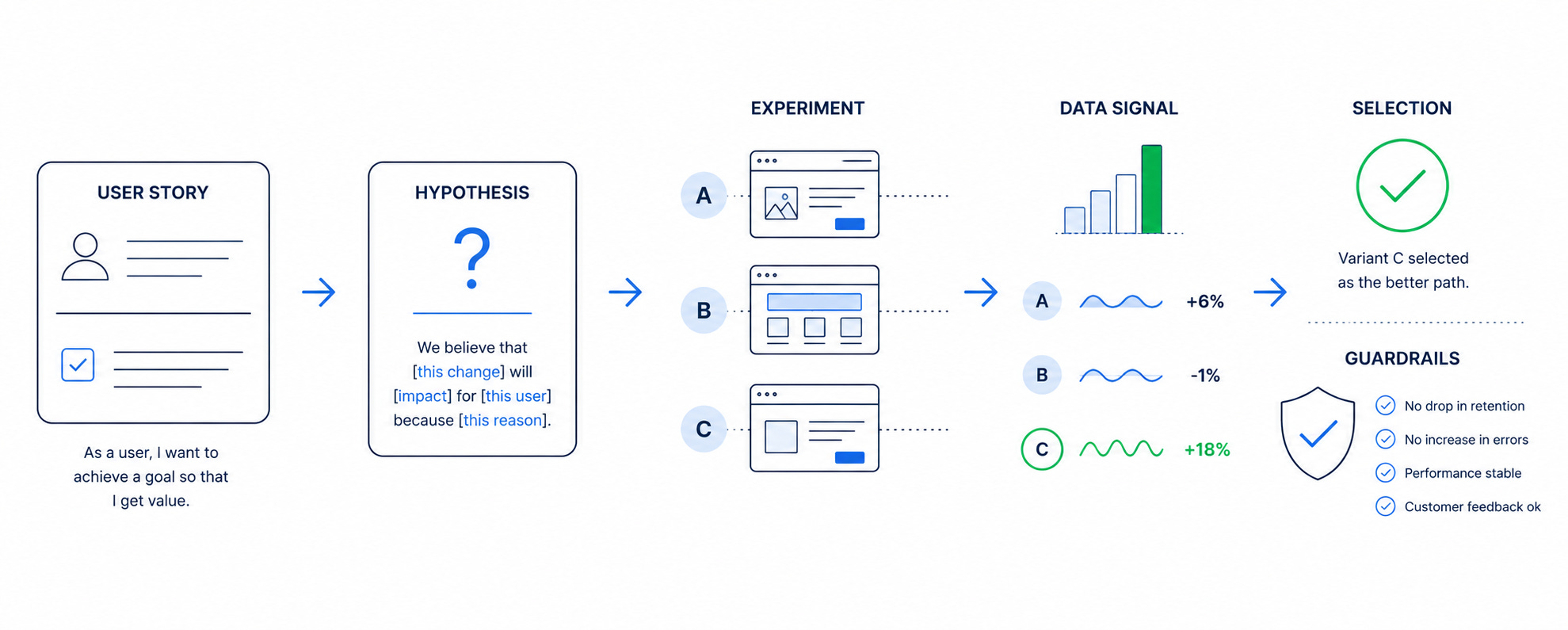
What happens to requirements when agents can build five variants quickly? User stories do not disappear, but they stop being enough as delivery commitments. The harder question is no longer whether we can build X. It is whether X is the right bet.
Why does analytics become the foundation? Thinking in bets is only useful if the team can see who was exposed, what they saw, what they did next, whether behavior changed, and whether guardrails moved. Analytics becomes the data substrate for both human decisions and agent-assisted decisions.
What is the validation stack? Feature flags, A/B tests, staged rollouts, cohort targeting, exposure tracking, telemetry, guardrail metrics, rollback paths, and experiment reviews move from “growth team practice” to core Scrum infrastructure.
How much can the system automate? Once humans define the KPI, guardrails, blast radius, and approval boundaries, the system can often continue a rollout, promote a clear winner, pause a loser, or alert humans when the signal is ambiguous. The “persevere” decision can increasingly be automated.
Where do humans still need to approve? Initial production deployment, high-blast-radius rollouts, pricing, legal or compliance-sensitive changes, irreversible data changes, trust-sensitive AI behavior, and ambiguous metrics still need human judgment.
What happens to the Scrum meetings? Sprint Planning becomes bet selection. Daily becomes an optional operator sync. Sprint Review becomes where bets meet reality. Retrospective becomes where culture and the system improve together.
The Thinking in Bets lens is useful here: a good decision can have a bad outcome, and a bad decision can get lucky. The point of the Review is not just to ask whether the feature “worked.” It is to ask whether the bet was well reasoned, whether the evidence was good enough, and what the team should change before the next bet.
Single takeaway: if requirements become hypotheses, rollout infrastructure becomes part of Scrum itself. Without analytics, flags, telemetry, guardrails, and experiment review, thinking in bets stays a slogan. With them, it becomes an operating system.
Powered by GPT-5.5 and NotebookLM.


